
Week of Mar 10
Exploring Fields Open House
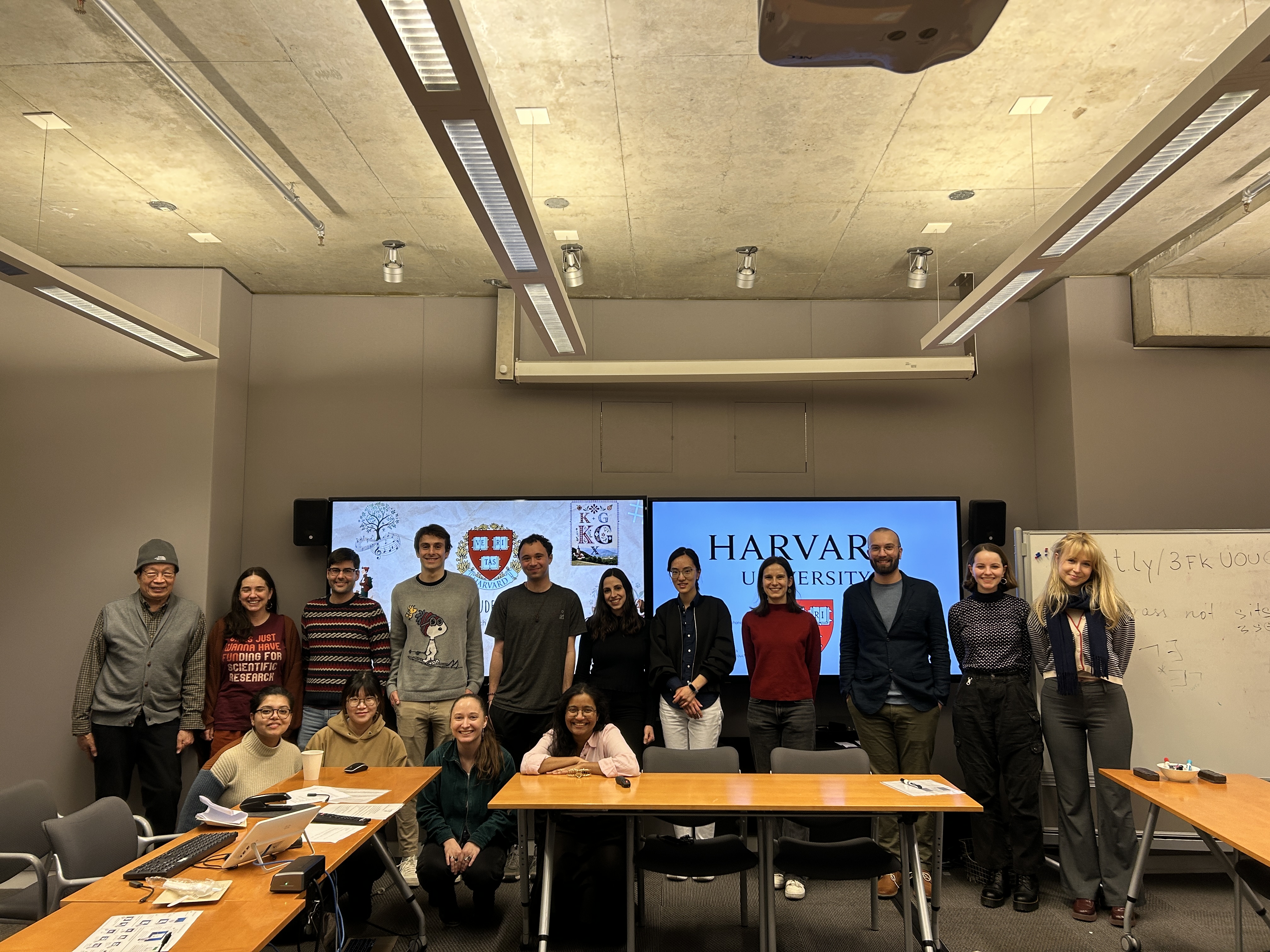
The undergraduate Open House this semester was held last Wednesday in the department lounge. Lots of students who are currently enrolled in LING courses stopped by, and had lovely conversations with faculties, graduate students and concentrators with delicious doughnuts! Thanks to everyone who came and helped make the Open House a success.


Graduate Student Workshop
The Annual Graduate Student workshop took place on March 7 at 90 MTA, featuring six talks from a variety of subfields in linguistics. A huge thank you to all the presenters for sharing their wonderful work, and to all the faculties, graduate students and postdocs who came to provide feedback! Let's all look forward to the next one!

(Pic: A poster with symbols representing all the talk titles, generated with Recraft v3 on flowith.net)
Harvard Linguistics Colloquium Talk Series
The third talk in the Harvard Linguistics Colloquium Talk Series in Spring 2025 is taking place this Friday March 14 at 12pm. The details can be found below (note that there is a change in location). Hope to see lots of you there.
Speaker: Megha Sundara
Title: When and how do infants discover morphological suffixes?
Time: Friday March 14, 12-1:30pm
Location: Emerson 305
Abstract: Suffixes like -s, -ed and -ing are the basic building blocks of English syntax. First, I will show that English-learning infants discover -s, then -ing, then -ed, in the first year of life, without access to meaning, function or word class. Next, I will use computational modeling to evaluate various mechanisms for affix discovery against the developmental trajectory uncovered in the infant experiments. Then, I will present infant experiments confirming two novel predictions of the successful model regarding when infants discover (a) specific allomorphs and (b) another suffix, -ie/-y. I will end by offering predictions for the trajectory of morphological acquisition in Spanish, French and German.
LangCog
The next LangCog meeting of the semester will be on Tuesday, March 11 from 5:30-7:00pm! It will take place in William James Hall, Room #1550. The speaker this week is Jacob Vigly, and the title and abstract of the talk can be found below. Food will be available at the meeting, and you can find the schedule for the remainder of the semester on our website.
Title: When unpredictable doesn’t mean difficult
Abstract: As you read this text, word by word, you build an understanding of what it means. What are the cognitive mechanisms underlying this ability? Under a rational analysis framework (Anderson, 1990) we can approach an answer to that question by viewing language comprehension as a probabilistic inference problem, where beliefs about the intended meaning are formed and updated as the utterance unfolds. An important and empirically well-documented feature of human language processing is that words that are unexpected tend to require more effort. This phenomenon has been described by the hypothesis that difficulty scales in log inverse probability, aka surprisal (Hale, 2001; Levy, 2008), a theory which is justified by the core intuition that changing beliefs comes as a cost, and that this cost can be measured in units of information, quantified by surprisal. This intuition also provides promising connection to a broad family of algorithms, in particular sampling-based methods of approximate inference, providing a tantalizing bridge between computational and algorithmic levels of analysis.
However, surprisal theory’s focus on word prediction may be too narrow. The primary aim of this talk is theoretical: I will start by motivating and formalizing the hypothesis that processing cost be measured directly with the divergence between belief distributions. This hypothesis formalizes surprisal theory's core intuition but is strictly equivalent only with certain commonly assumed simplifications that I propose may not be warranted in general. This more general framing inspires a novel class of empirical predictions about situations where surprisal may be expected to systematically overpredict processing cost. In the second part of the talk, I will examine typographical errors as one type of that are unpredictable without necessitating large changes in belief-state, and describe estimators of surprisal and belief-update in a noisy channel model of comprehension as inference about intended words. I'll present results of a self-paced reading time study targeted at these examples, which finds evidence that human processing cost tracks belief update size, rather than surprisal.