
Week of Mar 3
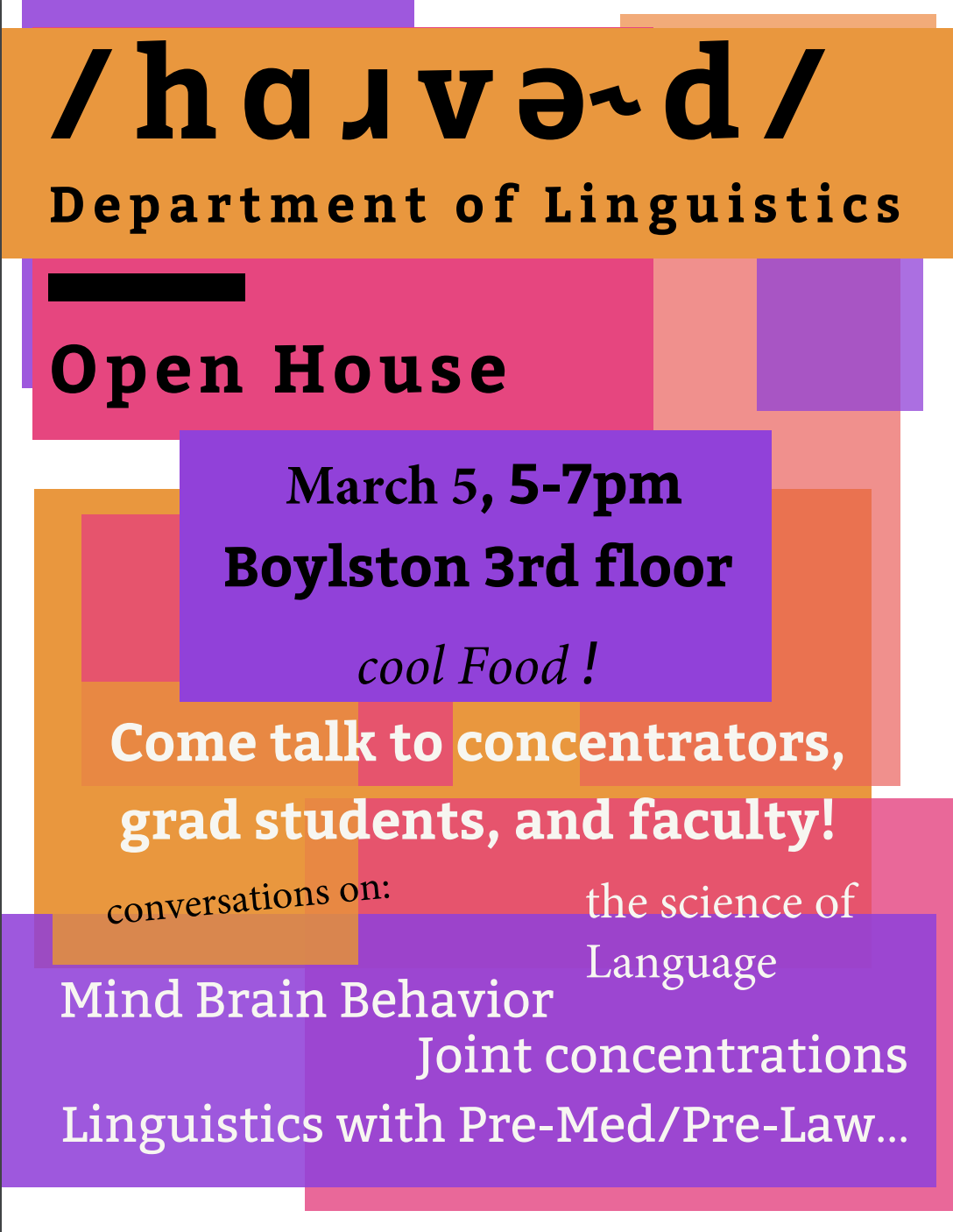
Exploring Fields Open House
The Department of Linguistics is holding its undergraduate Open House on Wednesday March 5 at 5pm in Boylston Hall in the 3rd Floor lounge. Please spread the word so that more people can get to know the fascination of linguistics! This is a great opportunity to talk to current concentrators, graduate students, and faculties about the program. See you all there!
LangCog
The next LangCog meeting of the semester will be on Tuesday, March 4 from 5:30-7:00pm! It will take place in William James Hall, Room #1550. Our speaker next week is James A. Michaelov, and the title and abstract of the talk can be found below. Food will be available at the meeting, and you can find the schedule for the remainder of the semester on our website.
Title: What can psycholinguistics and natural language processing learn from each other?
Abstract: While the idea that language comprehension involves prediction has been around since at least the 1960s, advances in natural language processing technology have made it more viable than ever to model this computationally. As language models have increased in size and power, performing better at an ever-wider array of natural language tasks, their predictions also increasingly appear to correlate with the N400, a neural signal of processing difficulty thought to reflect the extent to which a given word is expected based on its preceding context. In fact, the predictions of contemporary large language models can not only be used to model the effects of certain types of stimuli on the amplitude of the N400 response, but can in fact predict single-trial N400 amplitude better than traditional metrics such as cloze probability. With these results in mind, I will discuss how language models can be used to study human language processing, both as a deflationary tool and to support positive claims about the extent to which humans may use language statistics as the basis of prediction, bringing language in line with other cognitive domains. Finally, I will discuss how the close correlation between the predictions of language models and N400 amplitude means that we can use previous psycholinguistic research to identify possible unexpected patterns of behavior in state-of-the-art large language models.
GSAS Indo-European & Historical Linguistics Workshop
The eighth GSAS Indo-European & Historical Linguistics Workshop talk of the 2024-2025 academic year will take place this Friday. Marek Majer will be presenting research on Friday March 7 at 5 PM on ZOOM. Attendees may choose to attend on zoom or gather in-person in Boylston 335 (highly encouraged!). Please find all details below.
Speaker: Marek Majer (University of Lodz)
Time: Friday March 7 at 5 PM EST
Location: ZOOM or Boylston 335 (Linguistics department, third floor)
Zoom link: please contact the workshop coordinator Anabelle Caso
Title: Two riddles in Polabian etymology: 1) lekănaićă 'bird of prey'; 2) ją 'is
Abstract: This talk deals with two problems in the etymology and historical morphology of Polabian, the extinct westernmost attested Slavic language. The discussion includes references to Indo-European linguistics (specifically, the type of iteratives/intensives with the suffix *-eh₂-(ye-) and lengthened ē-grade in the root) as well as to typological considerations related to grammaticalization and morphological change.
Mandelkern at the Harvard Linguistics Colloquium Talk Series
The second talk for Harvard Linguistics Colloquium Talk Series of the semester was given by Matthew Mandelkern (NYU) on Friday February 28. The talk was titled "Disjunction and Possibility". Thank you so much for the though-provoking talk, Matthew!
