
Week of Apr 28
Hayley Ross Thesis Defence
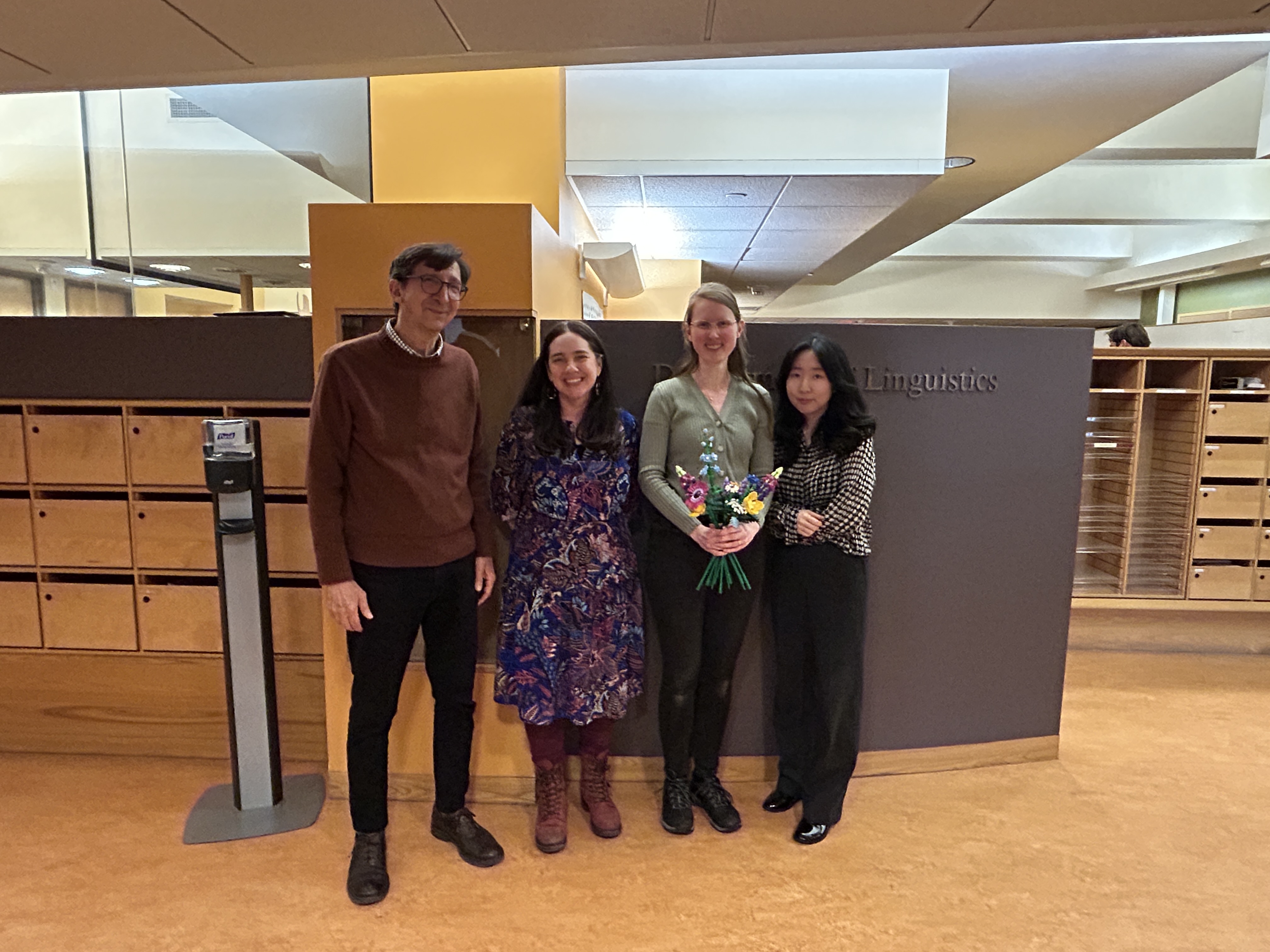
On April 16, our 5th-year PhD student successfully defended her thesis 'Artificial intelligence and fake reefs: what privative inferences and LLMs tell us about adjective-noun composition'. A reception with champagne was held in the department lounge after the defence to celebrate Hayley's PhD well done. A big thank you to all the faculties, graduate students, and concentrators from Harvard and BU Linguistics, as well as the M&M lab who came to enjoy Hayley's talk and witness her special moment. Congratulations, Dr. Ross!


Harvard at WCCFL 43
Faculty Kate Davidson gave an invited talk with her co-author Masashi Tamura (PhD student at Gallaudet Linguistics) at WCCFL 43 held at University of Washington in Seattle on April 25-27. The title of their talk was ‘Quantification and depicting predicates in ASL’. Congratulations, Kate and Masashi!

Bhattacharya Won the 3-Minute Thesis Finals
One of our senior concentrators, Antara Bhattacharya, won first place (with $1,000!) in the 3-Minute Thesis Competition organised by the Harvard College Writing Centre. The title of her thesis was 'AIlice in Numberland: Comparing Numerical Understanding in Language Models and Humans Through Multilingual Reasoning Puzzles'. Huge congratulations, Antara!

28th Annual Joshua and Verona Taylor Whatmough Lecture
The Department of Linguistics is proud to present the 28th Annual Joshua and Verona Taylor Whatmough Lecture. This year, our speaker is Paul Smolensky of the Department of Cognitive Science at the Krieger School of Arts and Sciences at Johns Hopkins. We encourage you to join us for this exciting talk!
Speaker: Paul Smolensky, Johns Hopkins Cognitive Science Department, Microsoft Research Deep Learning Group
Title: Do the syntactic abilities of generative AI systems falsify fundamental principles of generative linguistics?
Time: Tuesday, April 29, 2025 4:00pm
Location: Fong Auditorium, Boylston Hall. Reception to follow at the Harvard Faculty Club
Abstract: Do the impressive abilities of neural networks in form of Large Language Models to generate rich, well-formed syntax falsify fundamental principles of generative linguistic theory? In short, the answer I will argue for is: no. But it will be a rather nuanced “no”, trying to identify the proper treatment of generative AI for generative linguistics.
Specifically, I will consider these principles:
- Computability: Generating natural language with rich, human-level syntax requires use of symbolic grammatical rule systems.
- Explanation: Theoretical explanation in generative linguistics requires built-in discrete symbolic structure.
- Acquisition: Children’s ability to acquire language requires innate knowledge of grammatical rule systems.
- Universals: Linguistic universals can only be explained from innate limitations on what languages are learnable.
The quantity of discussion of these questions will decrease sharply from 1–4, the bulk of the presentation focussed on 1. The discussion of 1 takes off from joint work with Roland Fernandez, Herbert Zhou, Mattia Opper, and Jianfeng Gao (arXiv:2410.17498).
More on the speaker: Paul Smolensky is the Krieger-Eisenhower Professor of Cognitive Science at Johns Hopkins University and a Senior Principal Researcher in the Deep Learning Group at Microsoft Research Redmond. His work focuses on the integration of symbolic and neural network computation for modeling reasoning and, especially, grammar in the human mind/brain. This work created: Harmony Networks (a.k.a. Restricted Boltzmann Machines); Tensor Product Representations; Optimality Theory and Harmonic Grammar (grammar frameworks grounded in neural computation, developed jointly with A. Prince and G. Legendre); and Gradient Symbolic Computation. The work up through the early 2000’s is presented in the 2-volume MIT Press book with G Legendre, The Harmonic Mind. He received the 2005 David E. Rumelhart Prize for Outstanding Contributions to the Formal Analysis of Human Cognition.
Spring Reception
All are invited to attend the Linguistics Spring Reception on Thursday, May 1, 5-6:30 pm in the Ticknor Lounge on the 1st floor of Boylston Hall. Refreshments (and cake!) will be provided.

This is the last issue of the Spell-Out Blog this semester.
See you all back in September!