
Week of Mar 23
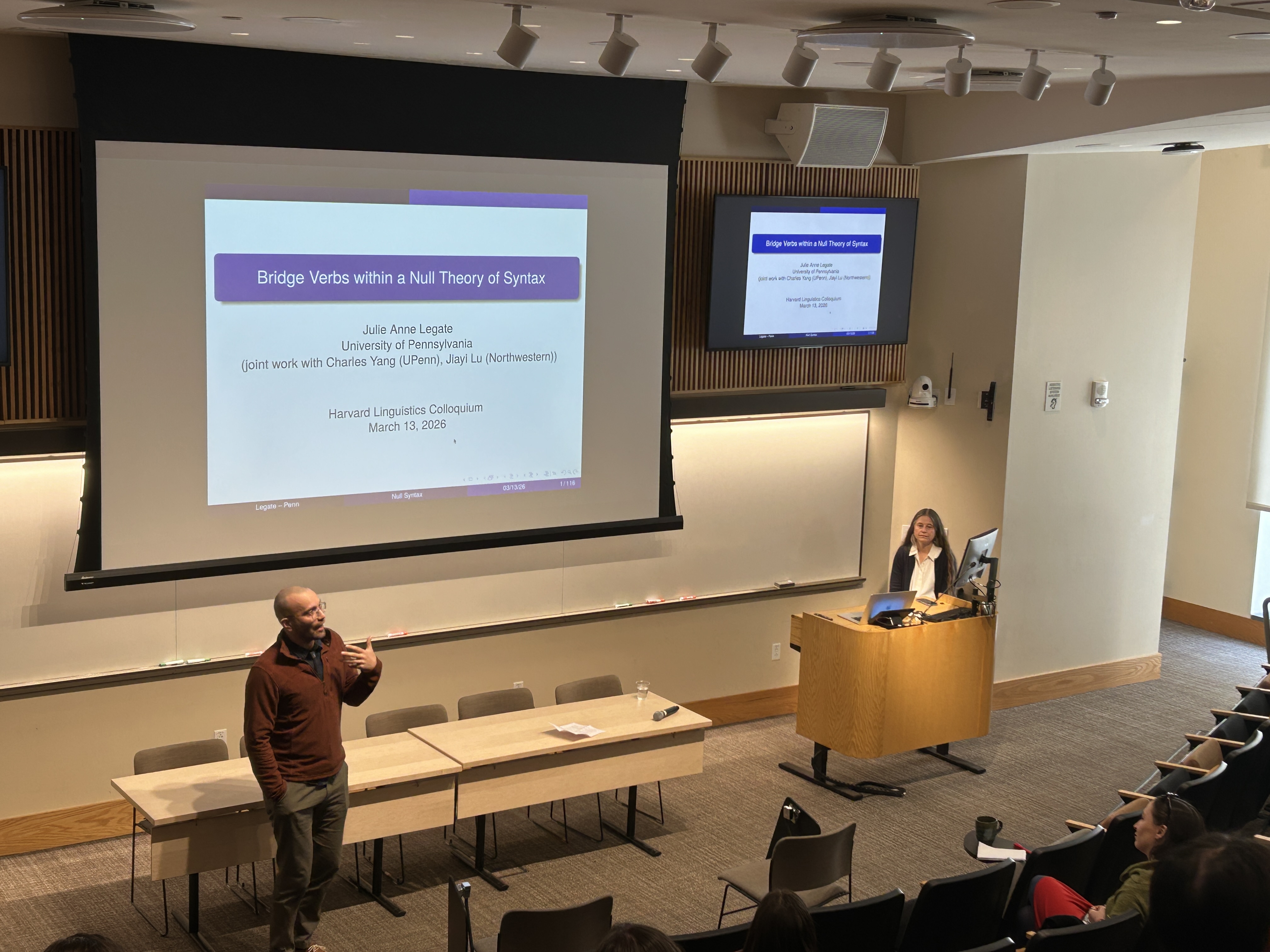
Julie Anne Legate at the Harvard Linguistics Colloquium Talk Series
Many thanks to Julie Anne Legate for a brilliant Harvard Linguistics Colloquium talk on 13 March! In her talk ‘Bridge Verbs within a Null Theory of Movement’, she drew on corpus and experimental data from English and Mandarin to revisit the bridge verb phenomenon within a theory of lexical learning and generalisation and proposed that children assume that no movement is possible until they receive evidence in the input that it is possible.
Thank you, Julie, for a fascinating and thought-provoking talk! 👏🔥
Senior Thesis Writers 2026
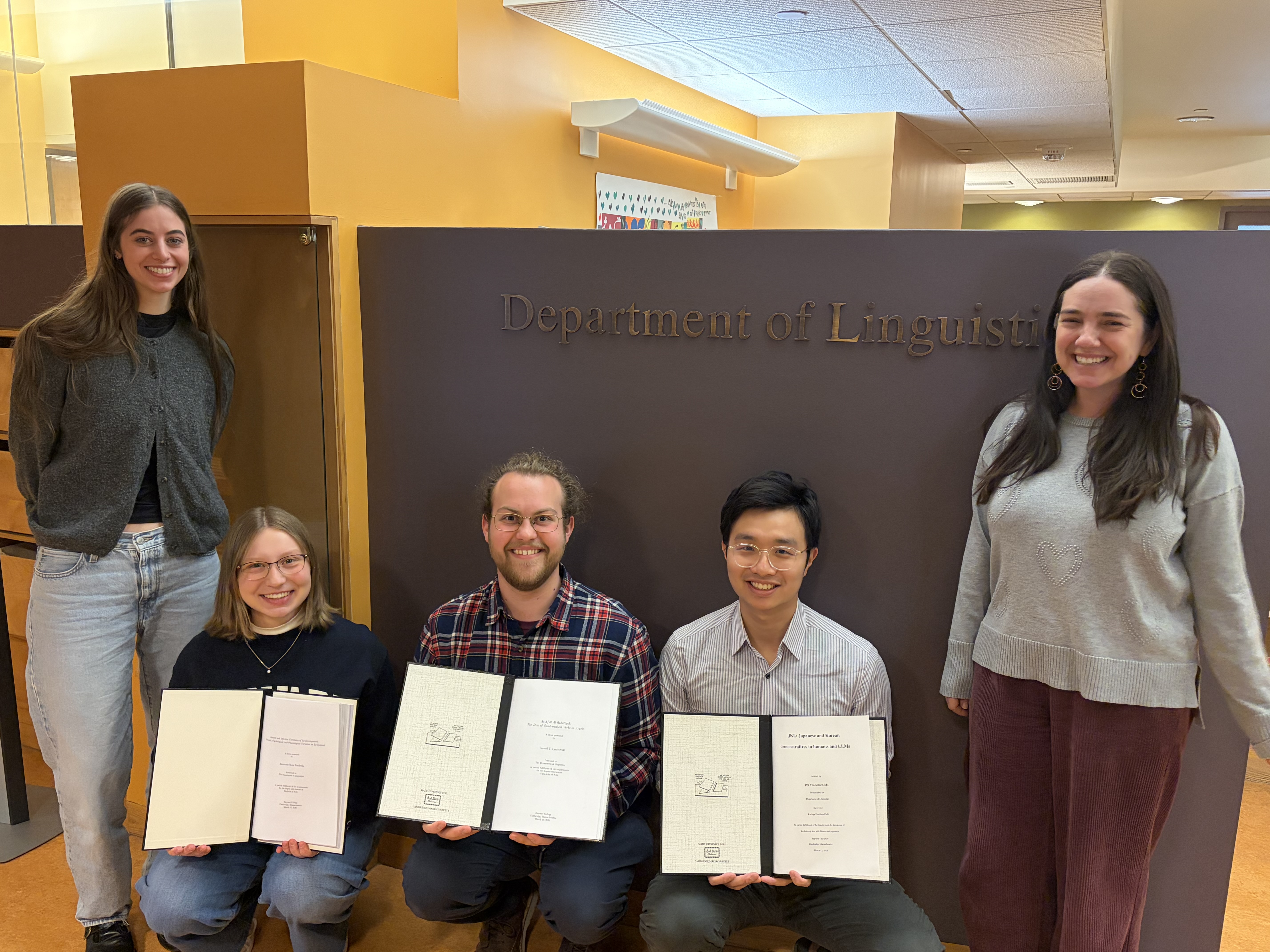
Congratulations to all of our Linguistics senior thesis writers for completing their theses on 13 March. Completing a thesis is a major achievement, and we are so proud of all the hard work, care, and intellectual curiosity that went into these projects. Here is a list of the senior thesis writers and their preliminary titles:
- Samuel Lyczkowski: "Al-Af‘āl Al-Rubā‘īyah: The Rise of Quadriradical Verbs in Arabic"
- Pei Yao Simon Ma: "JKL: Japanese and Korean demonstratives in humans and LLMs"
- Annmarie Raschella: "Acoustic and Affective Correlates of L2 Development: Prosodic, Psychological, and Physiological Variation in L2 Spanish"
Well done, everyone! We all look forward to hearing more about your research in April at the Senior Thesis Colloquium!
4th Annual Graduate Student Workshop
The 4th Annual Graduate Student Workshop is taking place this Friday, March 27. The venue for this year's workshop will be the Mount Auburn Room in the Smith Campus Centre. Breakfast and lunch will be provided. The list of presenters and the titles of their presentations will be circulated 1-2 days before the workshop.
Parent Panel Discussion Night
The ASL program is hosting a Parent Panel Discussion Night on March 31. For this event, we will invite parents of Deaf and hard of hearing children to share their experiences and perspectives as they navigated the process of securing ASL based educational services for their children.
The event is intended for educators, medical professionals, speech language therapists, and university students who may work with Deaf or HH children in the future. Members of the general public are also welcome to attend.

GSAS Indo-European & Historical Linguistics Workshop
We are excited to announce a talk in the GSAS Indo-European & Historical Linguistics Workshop this week:
Nadav Asraf will be presenting research on Friday, March 27, at 5 PM in Boylston 335.
Speaker: Nadav Asraf (Harvard University)
Time: Friday March 27 @ 5 PM
Location: Boylston 335 (Linguistics department, third floor)
Title: « ὁ δεῖνα ἐποίει » ‘X was making [this]’: The Employment of the Imperfect in Artists’ Signatures in Light of Homeric and Herodotean Usage
Abstract: While Ancient Greek artists typically signed their works using the Aorist (Χ ἐποίησεν, ‘X made [it]’), they also at times used the Imperfect (Χ ἐποίει, ‘X was making [it]’). At first glance, the Imperfect’s use to denote a completed action seems to contradict its usual function of marking ongoing or incomplete past activity. Yet literary evidence—especially in Homer and Herodotus—shows that the imperfect can denote completed actions, as long as the context, whether linguistic or extra-linguistic, makes it clear that the action has indeed reached its end. By exploring the structures and mechanisms that license this remarkable feature, the employment of the Imperfect in artists’ signatures gains a firmer footing.
LangCog
The next LangCog meeting of the semester will be Tuesday, March 24th, from 5:30-7:00pm, in William James Hall, Room 1550. The speaker is Anna Papafragou (University of Pennsylvania), and the title and abstract of the talk can be found below. You can find the schedule for the remainder of the semester on the LangCog website. Food will be provided, as always!
Title: Pragmatics and the acquisition of taxonomic nouns
Abstract: A long-standing idea in language acquisition is that the “basic” level of taxonomic nouns (“dog”) is privileged over both the broader, superordinate level (“animal”) and the more specific, subordinate level (“dalmatian”). This asymmetry has often been attributed to the perceptual naturalness of basic-level categories. In this talk, I suggest that children’s use and comprehension of taxonomic nouns do not necessarily reflect conceptual factors but often reveal pragmatic pressures that are also active in adult communicators. On this perspective, what learners find easy or hard to learn is determined not (only) by what is easy or hard to conceptualize but by what sorts of distinctions are more or less likely to be pragmatically useful (e.g., informative). I show that asymmetries in the acquisition of noun taxonomies can be understood in terms of children’s developing ability to take into account pragmatic principles. This approach leads to a rethinking of foundational assumptions in word learning, and reveals the pervasive role of pragmatics in early semantic development.